

How to Buy Engagement Ring Toronto
How to Buy Engagement Ring is a huge moment, and it all starts with two big questions: how much do you want to spend, and do you prefer a natural or a lab-grown diamond? Getting clear on these two things right from the start makes the whole process feel less overwhelming and a lot more exciting. It puts you in the driver's seat, ready to find a ring that’s a perfect symbol of your relationship without any financial stress.
Your First Steps How to Buy Engagement Ring
Let’s be honest, starting the search for an engagement ring can feel like a lot. But when you break it down, it really comes down to a few key choices. We'll walk through the most important questions first to set you up for a smooth, enjoyable experience from beginning to end.
Setting a Realistic Ring Budget
First things first, let's get rid of that old "three-month salary" rule. That was a clever marketing tactic from decades ago, and it has absolutely no bearing on what you should spend today. The right budget is a number that feels comfortable and responsible for your financial situation. This is a celebration, not a reason to go into debt.
The best way to figure this out? Talk about it. If you and your partner are making this decision together, have an honest chat about your shared goals. Maybe you’d both rather have a more modest ring and put that extra money toward a down payment on a house or an amazing honeymoon. When you align on a budget together, the ring truly represents your partnership from day one.
Key Takeaway: The perfect budget isn’t about tradition; it’s about your personal financial comfort. A ring symbolizes your future, and that future should be built on a solid foundation, not pressure to hit some arbitrary spending target.
This visual decision tree can help you map out that initial budget conversation, from including your partner to weighing your diamond options.
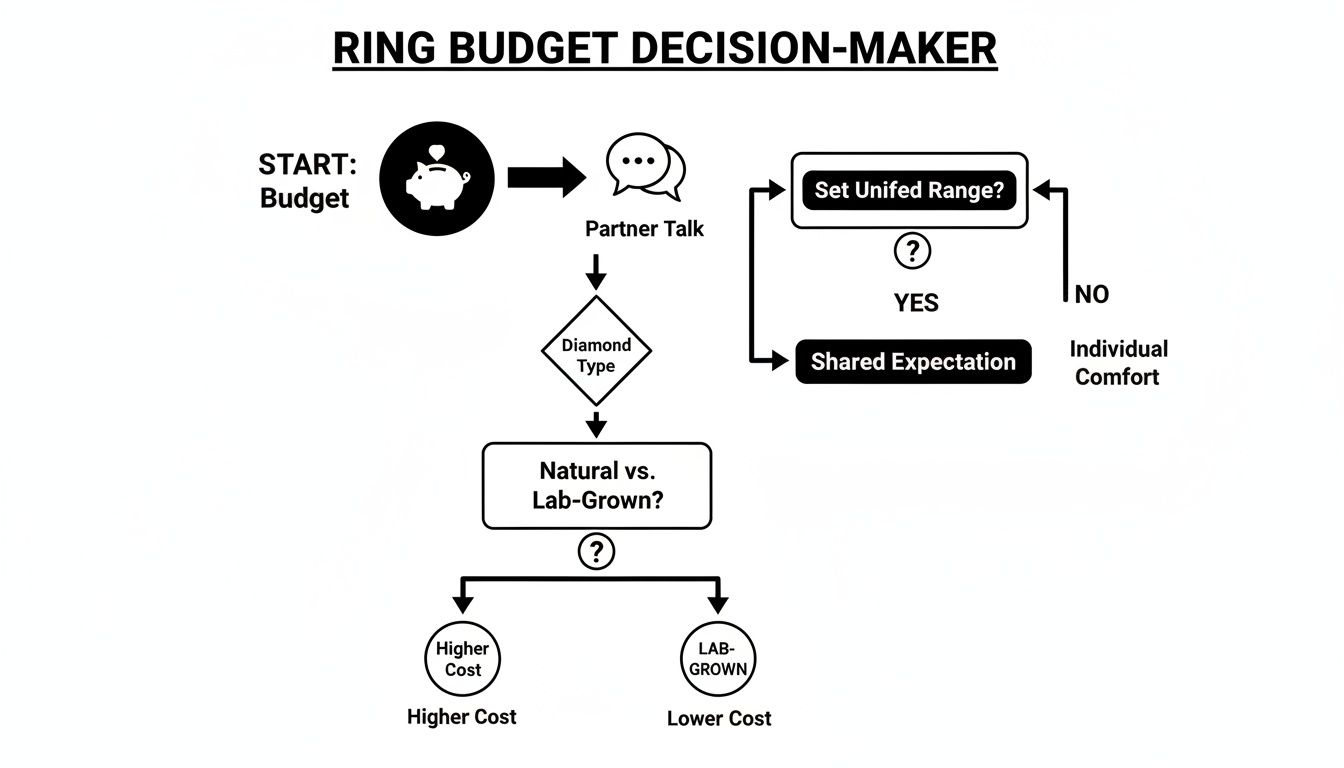
As you can see, your budget, conversations with your partner, and diamond choice are all connected, and they’ll guide every other decision you make.
Understanding Natural vs Lab-Grown Diamonds
Once you have a budget in mind, you’ll hit the next major fork in the road: choosing where your diamond comes from. This decision directly impacts the price, but it’s crucial to know that both options are 100% real diamonds—they are chemically, physically, and optically identical. Even a trained gemologist can't tell them apart without highly specialized equipment.
Here’s a quick rundown:
- Natural Diamonds were formed deep inside the Earth over billions of years and are brought to the surface through mining. For many, their appeal comes from their rarity and the romance of owning a piece of ancient history.
- Lab-Grown Diamonds are created in high-tech facilities that replicate the exact conditions under which diamonds naturally form. They have the same sparkle and durability as natural diamonds, just with a much shorter and more modern origin story.
To help you see the differences clearly, here's a quick side-by-side look.
Natural vs Lab-Grown Diamonds At a Glance
| Attribute | Natural Diamonds | Lab-Grown Diamonds |
|---|---|---|
| Origin | Formed over billions of years in the Earth's mantle | Grown in a lab setting in a matter of weeks |
| Composition | Identical chemical and physical properties | Identical chemical and physical properties |
| Price | Significantly higher due to rarity and mining costs | Typically 30-50% less for the same size and quality |
| Value | Traditionally hold resale value better over decades | Lower resale value, but offers more size/quality for the budget |
| Ethics | Sourcing can be complex; requires conflict-free certification | Guaranteed conflict-free and traceable origin |
For most people, the biggest difference comes down to the price tag. Lab-grown diamonds cost significantly less than natural diamonds of the exact same quality and size. Recent market data shows that in California, for example, lab-grown diamonds average around $5,188, while natural ones average $10,760. That price difference often means you can get a much larger or higher-quality diamond without stretching your budget. You can find more state-by-state engagement ring spending insights on Live Now Fox.
Ultimately, choosing between natural and lab-grown is completely personal. There's no right or wrong answer. It’s all about what you value more: the timeless story of a stone created by nature, or the modern value and guaranteed origin of a stone created by science. This decision is one of the biggest factors that will shape your final ring.
Looking Beyond the Standard 4Cs of Diamonds

Anyone who starts digging into how to buy an engagement ring quickly gets a crash course in the 4Cs—Cut, Colour, Clarity, and Carat. And while they’re absolutely essential for understanding a diamond's quality on paper, they don't tell the whole story. Not even close.
I’ve seen countless clients compare two diamonds with identical GIA reports, only to find they look wildly different in person. A grading report is just a map; a diamond's real beauty is found in the details that a certificate simply can't capture. It’s that intangible magic, that fire, that makes you feel something. This is where you graduate from being a student of the 4Cs and start seeing diamonds like a true professional.
Judging a Diamond's Real-World Performance
The single most important factor that isn't fully reflected on a lab report is a diamond’s light performance. This is the dazzling show of brilliance, fire, and scintillation that makes a diamond come alive. It's the dynamic dance of light that will catch someone's eye from across the room.
- Brilliance is the bright, white light that returns to your eye. Think of it as the stone’s overall sparkle and brightness.
- Fire is the explosion of rainbow-like colours that flash as the diamond moves. This happens when the diamond acts like a perfect little prism.
- Scintillation is the play of light and shadow across the facets as it moves—that blinking, flashing effect that creates contrast and visual excitement.
A truly exceptional diamond has a beautiful, harmonious balance of all three. It looks crisp and vibrant, not glassy or flat. The only way to judge this properly is to see the diamond with your own eyes, under different kinds of light.
A classic mistake is falling for a diamond under the intense, direct spotlights of a typical jewellery store. Those lights are designed to make any stone look amazing. To see a diamond’s true personality, you need to see it in the real world.
Ask your jeweller to show you the stone in diffused lighting, like near a window on an overcast day. Even ask to see it in a low-light setting. This will show you how the ring will actually look in your day-to-day life—in the office, at a restaurant, or just at home.
Understanding a Diamond's Unique Character
Beyond technical performance, every single diamond has its own character. This is shaped by the specific pattern of its facets and the nature of its inclusions. While one person might be hunting for a technically flawless stone, another might fall completely in love with a diamond because of a tiny, unique inclusion that makes it truly one-of-a-kind.
For example, a VS2 clarity diamond might have a tiny crystal near the edge that’s completely invisible to the naked eye but gives the stone a unique fingerprint. That’s part of its story. Character is all about finding a stone that speaks to you, not just one that checks off boxes on a lab report. For a deeper dive into these nuances, especially between different types of diamonds, our ultimate buying guide on lab-grown vs natural diamonds offers much more detail.
What to Ask Your Jeweller
When you’re ready to look at diamonds, having the right questions prepared will help you uncover their true quality. This is where leaning on an expert’s guidance becomes invaluable.
Here are a few key questions I always encourage my clients to ask:
- Can you show me the light return on this diamond? A great jeweller will be able to point out the specific patterns of light and dark, explaining exactly why one stone performs better than another.
- How does this compare to another diamond with the same grades? Putting two stones with identical specs side-by-side is the fastest way to see the difference. The contrast in performance and character will become immediately obvious.
- Are there any inclusions that might affect its durability? Inclusions near the girdle (the diamond's thin edge) can sometimes pose a structural risk, so it’s always smart to ask.
- Can we look at this stone under different lighting? This should be non-negotiable. Step away from the counter and see it in natural, ambient light.
By focusing on real-world performance and character right alongside the 4Cs, you’re ensuring you choose a diamond that doesn’t just look good on paper—it will look absolutely breathtaking on their hand, every single day.
Custom Design vs. Ready-to-Wear: Which Path is Yours?

This is one of the most exciting forks in the road when you’re figuring out how to buy an engagement ring. Will you pick a stunning, finished piece from a collection, or will you create something completely from scratch? Honestly, there’s no wrong answer here. It really boils down to your timeline, your budget, and just how personal you want the ring to feel.
A ready-made ring offers that instant connection. You see it, you try it on, you fall in love, and you can often walk out the door with it. It’s a faster, more direct path, especially if you happen to find a design that feels like it was made just for you.
But the custom design process? That’s a whole different kind of magic. It's a journey where you get to build a ring from the ground up, weaving in personal stories, secret symbols, or even giving a cherished family stone a new life. This is your chance to craft a true one-of-a-kind piece.
The Allure of a Custom Engagement Ring
Going custom puts you right in the designer’s seat. It’s less of a transaction and more of a creative partnership, a back-and-forth where your ideas are sketched, refined, and ultimately brought to life. The whole experience becomes a memorable part of your engagement story.
Think about it: you could design a ring that secretly incorporates the coordinates of where you first met or reset a grandparent's diamond into a setting that feels modern and completely you. These are the kinds of details that turn a piece of jewellery into a personal legacy.
The custom route is a perfect fit for you if:
- You value uniqueness. You want a ring that’s truly the only one of its kind, reflecting your partner’s individual style.
- You have a specific vision. Maybe you’ve searched everywhere but just can’t find that perfect combination of diamond shape, setting, and metal.
- You want to include heirlooms. You have family stones or gold you’d love to work into the design, beautifully blending the past with your future.
From Our Studio: The real beauty of the custom process isn't just the ring you walk away with—it's the experience of creating it. Working directly with a designer, you get to understand the craftsmanship behind every decision, ensuring every single element has a purpose and a story.
While it's an incredibly rewarding path, it does require more time. You should plan for a timeline of six to twelve weeks from the first chat to the final piece. The key is to find a designer whose work you genuinely admire and who you feel truly listens to your ideas.
The Advantages of a Ready-Made Ring
Opting for a ready-made—or "off-the-shelf"—ring has its own distinct advantages, especially when it comes to speed and certainty. The biggest plus? What you see is exactly what you get. There are no surprises, which can be a huge comfort during such a significant time.
This is the ideal path if you're on a tighter schedule or if you’re someone who feels more confident seeing and feeling the finished piece before making a decision. For a deeper look at how this choice impacts the numbers, our guide to custom vs store-bought engagement ring costs in Toronto can offer some valuable perspective.
Consider a ready-made ring if:
- Your timeline is tight. You have a proposal date in mind and can’t wait a few months for a custom piece to be made.
- You prefer certainty. You’d rather purchase something you can physically see and try on before committing.
- You’ve fallen for a classic design. You found a timeless solitaire or a stunning halo setting from a designer you trust, and it just feels right.
In the end, it’s all about matching the process to your personality. Do you get excited by the creative journey and the absolute personalization of a bespoke ring, or do you prefer the beautiful simplicity and immediacy of a finished piece?
Selecting the Perfect Setting and Precious Metal
So, you’ve found the perfect diamond. Now it’s time to give it a home. The setting and metal you choose are far more than just functional parts; they’re what transform that stone into a finished ring with a distinct personality. This is where your partner's personal style really shines through, defining everything from the overall look to how it feels to wear every day.
Think of it this way: the diamond is the art, and the setting is the frame. A simple, elegant frame lets the art speak for itself, while a more elaborate one becomes an integral part of the masterpiece. Each style tells a different story.
Finding the Right Setting Style
Getting familiar with the most popular setting styles is the easiest way to figure out what feels right for your partner. Every design strikes a unique balance between sparkle, simplicity, and security.
Most of the designs you'll see are variations of three foundational styles:
- The Solitaire Setting: The undisputed classic. A single diamond held by prongs (usually four or six) makes the stone the absolute star of the show. It’s elegant, timeless, and all about showcasing the diamond's fire.
- The Halo Setting: If you're looking for maximum impact, the halo is your best friend. A frame of smaller diamonds circles the centre stone, making it look significantly larger while adding an incredible amount of sparkle. It’s a hugely popular choice for a reason.
- The Pavé Setting: Pronounced "pah-vay," this style features a band that’s literally "paved" with tiny diamonds set close together. This creates a brilliant, unbroken line of light that draws your eye right to the centre stone. It’s pure glamour.
We're seeing more and more couples move away from tradition to focus on what feels authentic to them. Outdated rules about how much to spend are out the window. In fact, modern trends show that nearly 30% of people are choosing unique settings like halos or vintage-inspired designs to truly capture their personal style.
Choosing the Best Precious Metal
The metal you pick for the band is just as crucial as the setting. It sets the tone for the ring’s overall colour, determines its durability, and affects how much maintenance it will need down the road.
Platinum and white gold give off a cool, modern vibe, while yellow and rose gold feel warmer and more romantic. The right choice often comes down to your partner's skin tone, what jewellery they already wear, and the level of upkeep you're both comfortable with.
Here’s a quick rundown of the main contenders:
| Metal | Appearance & Feel | Durability & Maintenance |
|---|---|---|
| Platinum | A naturally bright white metal that develops a soft, beautiful patina over time. It’s the densest option, so it feels satisfyingly substantial on the hand. | Exceptionally durable and hypoallergenic. When it gets scratched, the metal is just displaced, not lost. It needs an occasional polish to restore its high shine. |
| White Gold | A stunning, bright white metal. It's yellow gold mixed with white alloys, then plated with rhodium for that brilliant, mirror-like finish. | Very strong, but the rhodium plating will wear away over time. To keep it looking its best, it needs to be re-plated every few years. |
| Yellow Gold | The quintessential classic. Its rich, warm colour is a beautiful complement to both diamonds and a wide range of skin tones. | A timeless and durable choice. Scratches can be easily polished out, making it fairly low-maintenance. |
| Rose Gold | A warm, pink-hued metal created by alloying gold with copper. It has a uniquely romantic, almost vintage feel that stands out. | The copper content makes it quite durable. Its colour is permanent and can deepen slightly with age, which helps hide minor scratches. |
Here’s an insider tip we share with our clients all the time: consider mixing metals. Pairing a platinum head (the prongs holding the diamond) with a yellow or rose gold band is a fantastic way to get the best of both worlds. Platinum prongs are incredibly secure and won’t cast any yellow tones into the diamond, keeping it bright and white. Meanwhile, the band keeps that warm, classic look you love. It’s a win-win for both style and security.
Nailing the Final Details: From Sizing to Your Design Consultation
You’ve navigated the big decisions—the diamond, the style, the overall vision. Now it’s time to focus on the small but crucial details that bring it all together for a flawless proposal. This is where we get practical, starting with one of the most common worries for anyone planning a surprise: getting the ring size right.
First, take a deep breath. Getting the size slightly off is a very common scenario, and it's almost always an easy fix. Most jewellers, including us, offer a complimentary first resizing. So, while it's great to get it perfect, don't let this detail stress you out.
How to Discreetly Figure Out Their Ring Size
If you're keeping the proposal a secret, you’ll need to do a little detective work. Here are a few tried-and-true methods we've seen work for our clients.
If your partner already wears rings, you're in luck. The easiest trick is to "borrow" a ring they wear on their ring finger (or a similarly sized finger) when they aren’t looking. You can either trace the inside circumference on a piece of paper or, even better, press it into a bar of soap to create a perfect impression for your jeweller.
No rings in their current collection? Time to call in some backup. A trusted friend or family member can be your secret weapon. They could plan a casual shopping trip and suggest popping into a jewellery store "just for fun," where your partner might get their finger sized without suspecting a thing.
A few other clever approaches include:
- The String Test: This one requires a steady hand and a deep sleeper. Gently wrap a piece of string or dental floss around their ring finger, mark where it overlaps, and measure it.
- The Comparison Trick: If you know your own ring size, try on one of their rings. Does it fit your pinky finger? Mark where it sits. A good jeweller can often make a surprisingly accurate estimate from that information.
- Just Ask: It might sound counterintuitive, but if you've already discussed marriage, sometimes the most direct path is the best.
Understanding Your Engagement Ring Timeline
This is a big one. Crafting a beautiful, meaningful ring takes time, especially if you’re going the custom route. Underestimating the timeline is a common mistake that can add unnecessary stress to what should be an exciting process.
Plan ahead to avoid the last-minute scramble. For a completely custom design, it’s smart to give yourself at least six to twelve weeks from the first consultation to the final pickup. This gives us ample time for detailed design work, sourcing the perfect stone, and allowing for meticulous hand-craftsmanship without rushing.
Even if you select a ready-made ring from a collection, remember to account for potential resizing. Depending on the complexity of the band (for example, a pavé band requires more delicate work), resizing can take anywhere from a few days to a couple of weeks. Always confirm the specific timeline with your jeweller before you buy.
Making the Most of Your Jeweller Consultation
Your consultation is where the magic really begins to happen. Walking in prepared transforms the meeting from a simple Q&A into a productive, collaborative design session. This is your chance to see diamonds and settings up close, ask every question you can think of, and build a real connection with the person crafting your ring.
To ensure a great meeting, try to bring a few key things:
- Your Inspiration: A few photos of rings or styles your partner loves can speak volumes.
- Your Budget: Being open about your budget helps your jeweller show you the most beautiful and impactful options within your range.
- Your Questions: Jot down a list. Ask about their design process, where they source their materials, and what warranties or policies they have.
This conversation is how your ideas start to take physical form. A skilled jeweller won't just sell you a ring; they'll listen to your story, get a feel for your partner’s personality, and guide you to a design that truly represents your relationship. The more you share, the better they can turn your vision into a stunning reality.
Ready to take that first step? You can easily book your free, no-pressure design consultation with us to start the conversation today.
Tying Up Loose Ends: Your Final Questions Answered
Even after mapping out the entire process, there are always a few lingering questions that come up. I get it—this is a big decision! Let's tackle some of the most common things people ask right before they take the leap. Think of this as the final check-in to make sure you feel 100% confident.
GIA vs. IGI: What's the Real Difference in Diamond Certification?
When you’re looking at diamonds, you’ll see acronyms like GIA and IGI everywhere. Think of these as the diamond’s official resumé, graded by an unbiased third party. Both labs are highly respected, but they’ve carved out different specialties in the industry.
-
GIA (Gemological Institute of America) is the heavyweight champion for natural diamonds. Their grading standards are famously strict and consistent, which is why a GIA report is considered the gold standard for resale and insurance on a natural stone. If you're buying natural, this is the name you want to see.
-
IGI (International Gemological Institute), on the other hand, has become the go-to authority for grading lab-grown diamonds. They provide incredibly detailed reports, often including light performance data that GIA doesn't typically offer.
So, for a natural diamond, a GIA certificate gives you ultimate peace of mind. For a lab-grown diamond, an IGI report is the industry standard and just as trusted. The key takeaway is that your diamond must have a report from a reputable independent lab to verify exactly what you're buying.
How Much Should I Actually Spend on an Engagement Ring?
Okay, let's clear the air on this one for good: please, please ignore the "three months' salary" rule. That was a brilliant marketing campaign from decades ago, not a piece of sound financial advice.
The right amount to spend is what feels comfortable for you and your partner. It's a number that fits your life and your financial goals without adding a mountain of debt or stress to the start of your marriage.
A Jeweller's Perspective: An engagement ring is a symbol of the future you're building together. That future deserves to start with security and joy, not a financial hangover. The real value is in the commitment, not the carat or the cost.
So many couples we work with would rather put that money towards a down payment on a house, an unforgettable honeymoon, or their wedding day. The focus should always be on what the ring represents, not a price tag dictated by some old-school tradition.
Is it Actually Safe to Buy an Engagement Ring Online?
It absolutely can be, provided you do your homework and partner with a reputable jeweller. Shopping online often gives you access to a massive selection and great value, but you need to know what to look for to make sure the experience is a good one.
A trustworthy online jeweller will always have these things:
- Top-Notch Visuals: Insist on seeing 360-degree videos and high-resolution photos of the actual diamond you’re considering, not just a generic stock photo.
- Reputable Certifications: You should be able to view the full GIA or IGI certificate for any diamond before you even think about adding it to your cart.
- Clear, Fair Policies: A solid return policy (at least 30 days) and free, fully insured shipping are non-negotiable.
- Access to an Expert: The best online jewellers now offer virtual consultations, so you can still get that one-on-one guidance from a real gemologist.
What Happens If I Get the Ring Size Wrong?
First, take a deep breath. This is one of the most common worries, and it's almost always a straightforward fix.
Most jewellers, our studio included, offer at least one complimentary resizing within a certain window after you buy the ring. It's just part of the service.
That said, some designs are trickier than others. An eternity band, with diamonds set all the way around, often can't be resized at all. If you're totally guessing on the size but have your heart set on a complex style, a great move is to propose with the loose diamond in a simple, temporary "placeholder" setting. This keeps the surprise and lets you design the final, perfectly-sized ring together later. Always ask about the resizing policy for the specific ring you're eyeing before you buy.
At Design by Sevan, we believe creating the ring should be just as memorable as the proposal. We're here to answer every question with total transparency and guide you through the process with care. Start your custom design journey with a free, no-pressure consultation today.