

Guide to Lab Grown Diamonds Canada
More and more, Canadian couples are choosing lab-grown diamonds, and it’s easy to see why. These aren’t fakes or imitations; they have the exact same chemical, physical, and optical properties as diamonds pulled from the earth. The only difference is their origin.
I like to think of it like this: you can find a beautiful rose growing in the wild, or you can get a perfect one from a high-tech greenhouse. Both are 100% real roses. One was just created in a controlled, sustainable environment. Lab-grown diamonds are the greenhouse rose of the diamond world—a modern marvel that offers an ethical alternative without sacrificing an ounce of sparkle.
Why Canada Is Embracing Lab-Grown Diamonds
The move toward lab-grown diamonds here in Canada isn't just a passing fad. It’s a real shift in how we think about luxury, value, and what matters to us. Couples from Toronto to Vancouver are figuring out they don't have to trade off between the size of the stone, its quality, and their conscience. Lab-grown diamonds deliver on all three fronts, which really clicks with Canadian sensibilities.
At the heart of it all is a simple fact: lab diamonds are real diamonds. They are not simulants like cubic zirconia or moissanite. They’re made of pure carbon atoms arranged in the exact same crystal structure as their mined cousins, making them impossible to tell apart with the naked eye. The only thing separating them is how they came to be—one is a product of technology, the other a product of geology.
The Key Drivers of Popularity
This wave of popularity is being pushed by a few powerful factors that really connect with today’s buyers:
- Serious Cost Savings: This is probably the biggest draw. Lab-grown diamonds can be anywhere from 30-70% less expensive than natural diamonds of the same size and quality. That means you can get a bigger, better stone without blowing your budget.
- Guaranteed Ethical Sourcing: Every single lab-grown diamond comes with a clear, traceable, and conflict-free origin. This transparency completely sidesteps the dark history of "blood diamonds," giving you total peace of mind.
- A Smaller Environmental Footprint: While creating anything has an impact, growing a diamond in a lab avoids the massive land disruption, heavy water usage, and ecological damage that comes with traditional mining.
For many Canadians, a big purchase like an engagement ring should say something about who they are. Lab-grown diamonds let you own a stunning, authentic diamond that also reflects a commitment to a more transparent and sustainable world.
This guide is designed to walk you through the science behind these incredible gems, show you how to judge their quality using the classic 4Cs, and help you make a smart, confident choice for one of the biggest moments in your life.
The Science of Creating Flawless Diamonds
Walking into a modern diamond lab is an incredible experience. It feels like stepping into the future, where scientists have managed to compress a billion-year-old geological process into a matter of weeks. They’re not making fakes or imitations; they’re creating gems that are physically, chemically, and optically identical to those pulled from the earth.
So, how do they do it? The whole process is about recreating the exact, intense conditions under which diamonds form naturally. It all starts with a tiny, high-quality diamond “seed”—a sliver of a pre-existing diamond. This seed acts as a blueprint, a foundation for a new, larger diamond to grow, atom by atom.
The High-Pressure, High-Temperature (HPHT) Method
The first major technique is called High-Pressure, High-Temperature, or HPHT. The name says it all. Imagine a high-tech pressure cooker designed to perfectly replicate the crushing pressure and searing heat found deep within the Earth's mantle.
Inside a specialized press, the diamond seed is placed with a source of pure carbon, like graphite. The machine then subjects it to immense pressure—we're talking around 870,000 pounds per square inch—while heating the chamber to over 1,500°C. Under this incredible force, the carbon melts and starts crystallizing around the seed, growing into a new, rough diamond. It’s a brute-force method that gets stunning results.
The Chemical Vapour Deposition (CVD) Method
The other leading method is Chemical Vapour Deposition, or CVD. If HPHT is a pressure cooker, think of CVD as an atomic-level 3D printer. It's a newer, more finessed approach to building a diamond from the ground up.
Here, a diamond seed is placed inside a vacuum chamber. The chamber is filled with a carbon-rich gas (like methane) and heated. Then, microwave energy is used to break down the gas molecules. This causes a gentle "rain" of pure carbon atoms to fall and bond to the seed, meticulously building the diamond layer by layer. Over several weeks, a beautiful, high-purity diamond crystal takes shape.
The most important thing to understand is that both HPHT and CVD are not just making something that looks like a diamond—they are creating an actual diamond. The stable, controlled lab environment often results in diamonds with exceptional clarity and colour, frequently achieving a level of purity (Type IIa) found in only 2%of the world's mined diamonds.
This control and quality are just a couple of the reasons savvy Canadian buyers are increasingly drawn to the modern brilliance of lab diamonds.
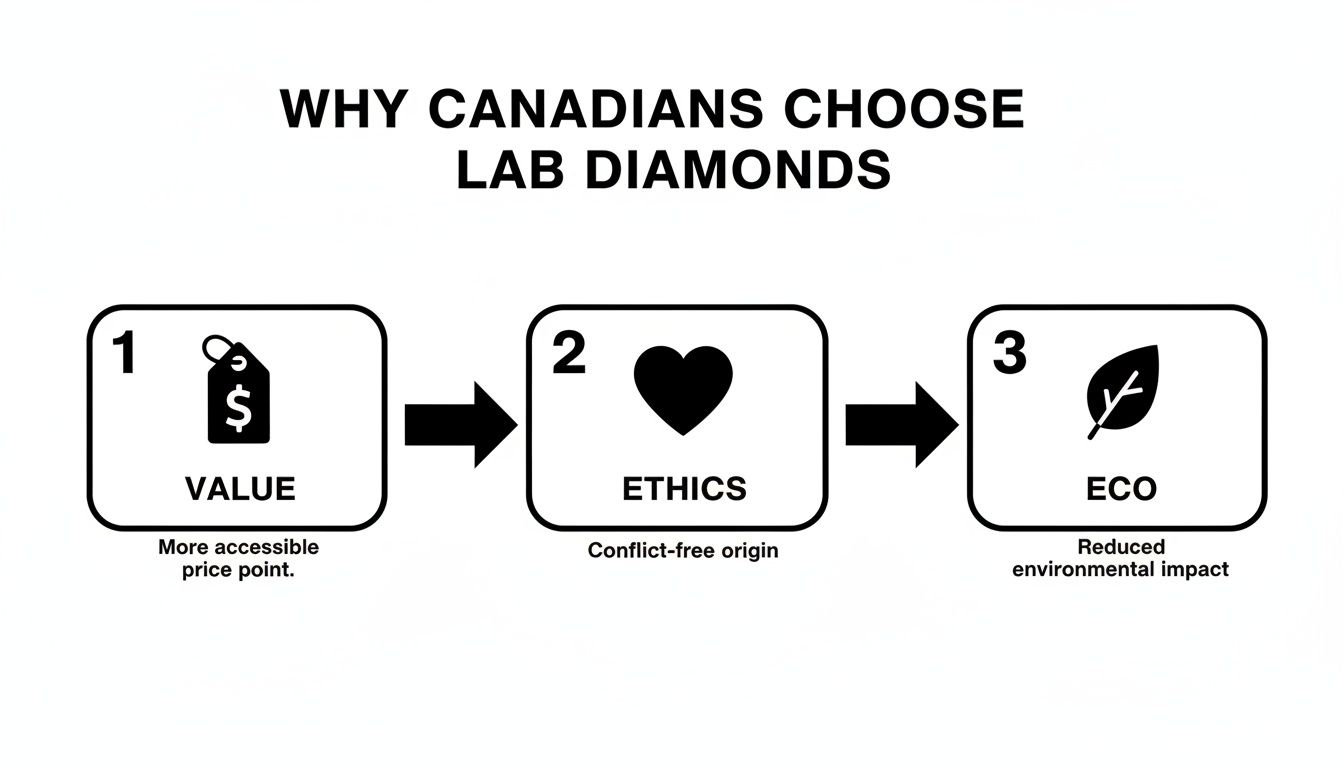
As you can see, it really comes down to a powerful combination: incredible value, a clear conscience, and a much smaller environmental footprint.
These technological advances have completely changed the game for anyone shopping for lab-grown diamonds in Canada. By taking geological luck out of the equation, labs can consistently create larger, higher-quality stones. For many Toronto couples, this has made a brilliant, eye-clean diamond of one, two, or even three carats a real possibility—something that might have felt out of reach before.
Ultimately, this precision science is what allows a studio like Design by Sevan to source exceptional stones time and time again. It ensures every diamond selected for a custom piece meets the highest standards of beauty and performance, giving you incredible sparkle without compromise.
Judging a Diamond's Quality and Value in Canada
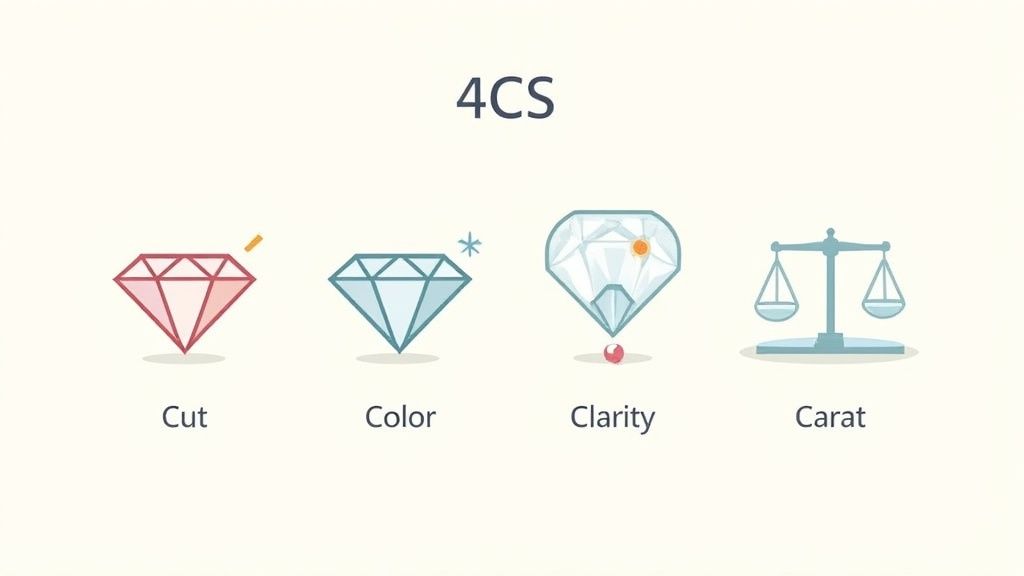
When it comes to choosing a diamond, the rules of the game are the same whether it came from a lab or deep within the earth. The very same standards for beauty and quality apply, and understanding them is your key to picking a stone with confidence. The industry-wide system for this is known as the 4Cs: Cut, Colour, Clarity, and Carat weight.
Think of this framework as your universal translator. It allows you to look at a lab-grown diamond in a Toronto studio and compare it directly to one you see online, ensuring you're making a true apples-to-apples comparison. Getting a handle on these concepts means you can find a stunning diamond that also represents fantastic value.
Unpacking the 4Cs for Canadian Buyers
Each of the 4Cs tells a part of a diamond's story and directly influences its appearance and price. And while they're all part of the equation, some have a much bigger impact on that sparkle you’re looking for.
- Cut: This is often called the most important 'C', and for good reason. It doesn’t refer to the diamond's shape (like round or oval) but to how well its facets interact with light. A masterfully cut diamond acts like a hall of mirrors, pulling in light and bouncing it back out as mesmerizing fire and brilliance. An excellent cut can even make a diamond look bigger and more lively, while a poor cut will make an otherwise great stone appear flat and dull.
- Colour: For a white diamond, this grade actually measures the absence of colour. The scale runs from D (perfectly colourless) down to Z (light yellow). Since lab-grown diamonds are created in a controlled setting, it’s quite common to find gorgeous stones in that top-tier D-G range. The more colourless the diamond, the more light can pass through it, maximizing its sparkle.
- Clarity: This tells you about the tiny imperfections found in nearly every diamond. We call them inclusions (if they're internal) and blemishes (if they're on the surface). The scale goes from Flawless (FL) to Included (I). The good news? Many of these are microscopic and completely invisible to the naked eye. A stone that is "eye-clean" is a smart way to manage your budget without sacrificing any visual beauty.
- Carat: This is simply a measure of the diamond’s weight, not its physical size. But because a diamond's price climbs exponentially with its carat weight, even a small jump can mean a big price difference. This is where lab-grown diamonds really shine.
The Undeniable Value of Lab-Grown Diamonds
For many Canadian couples, the most compelling reason to choose a lab-grown diamond comes down to incredible value. Since they don't involve the massive overhead of traditional mining, lab diamonds are significantly less expensive than natural stones of the exact same quality.
You’re not compromising; you’re just making a smarter financial choice. It's a trend we're seeing across Canada, with prices often 30% to 50% lower than mined diamonds. This shift has made beautiful, high-quality jewellery accessible to so many more people.
Let’s look at a real-world example to see what this means for your wallet.
Lab Grown vs Mined Diamond Price Comparison (1.5 Carat Example)
The table below breaks down the typical costs for a well-cut, high-quality 1.5 carat diamond here in Canada. The specs are identical—the only difference is the origin.
| Specification | Lab Grown Diamond (Avg. Price CAD) | Mined Diamond (Avg. Price CAD) | Potential Savings |
|---|---|---|---|
| Carat Weight | 1.50 | 1.50 | - |
| Cut Grade | Excellent | Excellent | - |
| Colour Grade | F | F | - |
| Clarity Grade | VS1 | VS1 | - |
| Approx. Cost | $4,500 | $16,000 | ~$11,500 (72%) |
As you can see, the savings aren't just small—they're transformative. That difference allows you to get a much larger or higher-quality stone than you might have thought possible.
Choosing a lab-grown diamond puts you in the driver's seat. It means you can afford to prioritize what truly matters to you, whether that's a larger carat weight, a perfectly colourless stone, or exceptional clarity, all without stretching your budget.
For a deeper dive into how these stones stack up, check out our ultimate buying guide comparing lab-grown vs. natural diamonds. You’ll quickly see how a lab-created diamond empowers you to get more brilliance and size for your money, turning a potential budget limitation into an exciting opportunity.
The Ethical Choice for Conscious Canadian Buyers
For a lot of Canadian couples, an engagement ring isn't just a beautiful piece of jewellery. It's a powerful symbol, and it needs to reflect their personal values. This is where the story behind a lab-grown diamond really starts to shine, making it as compelling as the stone's sparkle. Choosing a lab-created diamond gives you a clear path to conscious luxury, neatly sidestepping the tough ethical and environmental questions that come with traditional mining.
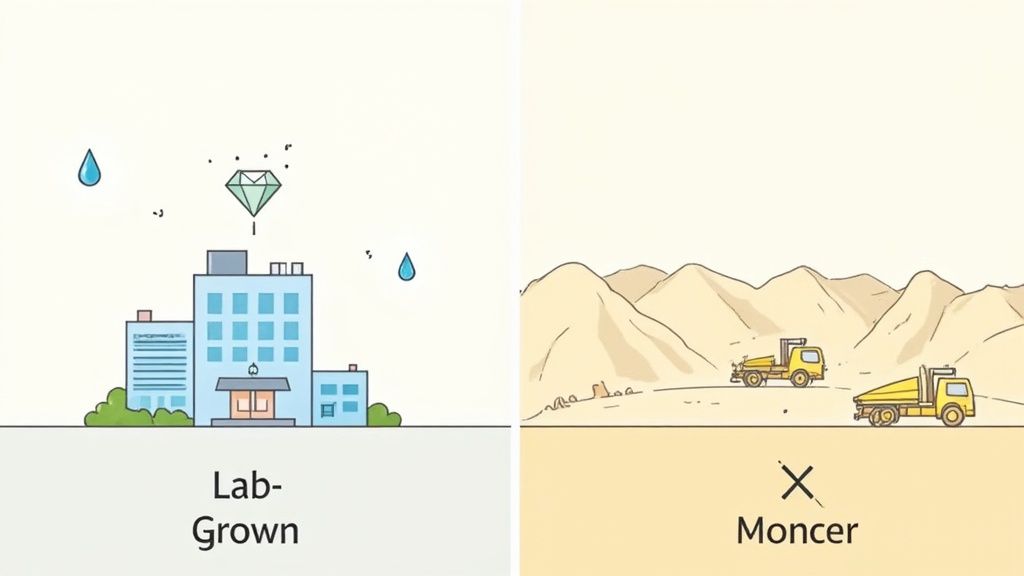
The biggest draw for many is the peace of mind that comes with a guaranteed conflict-free origin. The history of "blood diamonds"—stones sold to fund wars and civil unrest—has cast a long, dark shadow over the industry. And while systems like the Kimberley Process have helped, they aren't perfect.
Lab-grown diamonds wipe that concern off the table entirely. We know exactly where they come from: a controlled, high-tech facility. Their journey from a tiny seed to your ring is completely traceable and transparent. There's no grey area, no ambiguity—your diamond is 100% conflict-free.
A Lighter Footprint on the Planet
Beyond the crucial human element, the environmental difference between lab creation and mining is night and day. Diamond mining is an incredibly disruptive process. It literally moves mountains to pull gems from the earth.
Let’s put some numbers to that to see what it really means:
- Land Displacement: To get a single carat, miners can excavate up to 250 tonnes of earth. This leaves behind massive open-pit mines and mountains of waste rock, completely wrecking local ecosystems.
- Water Consumption: The process is also incredibly thirsty. Some estimates show it takes over 450 litres of water to mine just one carat.
- Carbon Emissions: Creating a diamond in a lab does take a lot of energy, but where that energy comes from makes all the difference. A lab running on renewable power has a tiny carbon footprint compared to a mine relying on diesel-guzzling machinery.
Growing a diamond in a lab, on the other hand, has a minimal physical footprint, uses far less water, and doesn’t disturb a single natural habitat.
Choosing a lab-grown diamond is a proactive step towards a more sustainable future for the luxury industry. It’s a decision that prioritizes transparency, accountability, and a minimized impact on our planet, allowing you to wear your beautiful stone with a truly clear conscience.
The Modern Definition of Ethical Luxury
At the end of the day, this choice reflects a real shift in how modern buyers, especially here in Canada, define value. It's not just about the 4Cs anymore; it’s about the entire story behind the stone. An ethical diamond isn't just beautiful—it's one that was brought into the world responsibly.
When you select a lab-grown diamond for a bespoke ring at a studio like Design by Sevan, you're choosing a gem whose origins are as pure as its brilliance. This modern marvel lets you celebrate your love without compromising your principles. It's a choice that feels good, looks stunning, and represents a forward-thinking take on an age-old tradition. You aren’t just buying a diamond; you're investing in a better standard for the entire jewellery industry.
Understanding Diamond Certification in Canada
When you invest in a diamond, you’re not just buying a beautiful stone; you’re buying confidence. That’s what a diamond certificate is all about. This grading report, issued by a respected gemological laboratory, is your non-negotiable proof of quality—a detailed blueprint of your diamond's unique characteristics.
Think of it as the official deed to a property. It's an independent, third-party verification confirming everything you need to know, from its precise measurements to its 4Cs grades. For anyone buying lab-grown diamonds in Canada, this document is your single most important piece of consumer protection.
Why You Absolutely Need a Certificate
A proper grading report guarantees transparency. It leaves no room for doubt about a diamond’s quality and, just as importantly, its origin. Without a report from a trusted lab like the Gemological Institute of America (GIA) or the International Gemological Institute (IGI), you’re essentially taking the seller's word for it—something no expert would ever recommend.
These labs don't just assess quality; they play a critical role in identification. Using advanced spectroscopic equipment, they can definitively determine if a diamond is natural or lab-grown. This distinction is the foundation for establishing fair value and ensuring you’re getting what you paid for.
How to Read a Diamond Certificate
At first glance, a certificate can seem a bit technical, but you only need to focus on a few key areas to get the full picture.
- Header and Report Number: This section will always state the diamond's origin in plain language. For a lab diamond, you’ll see terms like "Laboratory-Grown Diamond Report." No ambiguity there.
- Grading Results (The 4Cs): This is the heart of the report. It details the specific grades for Carat Weight, Colour, Clarity, and Cut, which collectively determine the stone's quality and value.
- Laser Inscription Registry: Nearly all certified diamonds are microscopically inscribed on their girdle (the thin outer edge) with the unique report number. The certificate will note this, and for a lab diamond, it will often include the phrase "LABORATORY-GROWN" as part of the inscription.
A grading report is more than just a piece of paper; it's your assurance that the diamond's quality has been impartially evaluated by the world's leading experts. It empowers you to compare stones accurately and make an informed decision with complete confidence.
The Legal Standing of Lab Diamonds in Canada
Let’s be perfectly clear: in Canada and around the world, lab-grown diamonds are legally recognized as real diamonds. They are chemically, physically, and optically identical to their mined counterparts, which is why they’re graded by the same institutions using the same tough standards.
However, consumer protection laws and industry ethics demand full disclosure. A jeweller is legally required to identify a diamond as 'laboratory-grown' or 'laboratory-created' at every step of the sale. This transparency is fundamental to the integrity of the jewellery industry and is a non-negotiable part of our practice.
This legal framework is there to protect you. It ensures you know exactly what you’re buying and can match the stone in your hand to its certificate. When you purchase a certified lab-grown diamond in Toronto, you’re getting a genuine diamond with a guaranteed and fully disclosed origin story—giving you total trust in both its beauty and its value.
Where to Buy Lab Grown Diamonds in Toronto
So, you’re ready to find the perfect lab-grown diamond in Toronto. The city has a fantastic jewellery scene, but with so many choices—from big-name retailers to small, independent studios—it can be tough to know where to even start.
Your search will probably take you down one of three paths. You have the large chain stores, the independent local jewellers, and the bespoke design studios like ours. Each offers a completely different experience, and the right one for you really comes down to what you're looking for.
Finding Your Fit: Where to Shop
When you're looking for lab grown diamonds in Canada, especially in a city like Toronto, think about what matters most to you. Is it seeing a huge selection all at once? Getting deep, one-on-one advice? Or creating something from the ground up that’s entirely yours?
- Established Retailers: These are the familiar names you see in shopping malls. The main advantage is convenience; you can walk in and see a lot of rings right away. The downside is that the experience can feel a bit transactional, and the staff might not have deep, specialized knowledge about lab diamonds.
- Independent Jewellers: Smaller, often family-run shops offer a more curated feel. The owner's passion and expertise usually shine through in the collection. This is a great middle ground where you can find unique pieces and get more personal service than you would at a large chain.
- Custom Design Studios: If you want a ring that’s a true reflection of your story, a bespoke studio is the way to go. It's a partnership. You'll work directly with a designer, not a salesperson, to hand-pick the perfect stone and build a setting around it. Every single detail is considered, from the way the diamond catches the light to how the band feels on your finger.
The real magic of a custom studio is the curation. An expert doesn't just pull up a database of stones. We sift through hundreds of options to find the few with exceptional life and brilliance—qualities a grading report alone can never capture.
The Smart Questions to Ask Your Jeweller
No matter where you end up, asking the right questions is your best tool. A good jeweller will be happy to answer them and should appreciate your diligence. Don't be shy.
- Can I see the diamond’s grading report? This is a must. Always ask for the certificate from a reputable lab like GIA or IGI. It’s the baseline for verifying what you're buying.
- How do you source your lab diamonds? This is a great way to gauge their expertise. A passionate jeweller will talk about more than just the 4Cs; they’ll mention looking for excellent light performance, avoiding colour tints, and steering clear of stones with hazy growth remnants.
- Can I compare a few diamonds side-by-side? This is the best way to train your own eye. Seeing stones next to each other makes it so much easier to spot the subtle differences in cut quality and colour that make one diamond stand out from another.
- Where is the actual ring made? It’s a simple question, but the answer is telling. Many stores sell pieces that are mass-produced overseas. A local Toronto studio that crafts everything in-house, like Design by Sevan, has far greater control over the final quality and supports local craftspeople.
If you’re starting your hunt online, which many people do, our guide on where to buy lab-grown diamonds online has some great pointers for making a smart, safe choice. It’s the perfect way to arm yourself with knowledge before you even step into a studio for a real, hands-on look.
The Bright Future of Lab Diamonds in Canada
The conversation around lab-grown diamonds in Canada has moved far beyond just being a trend. It’s a genuine shift in how we think about luxury, what we value, and how we choose to express ourselves. As we’ve explored, these stones aren’t just an alternative to mined diamonds; for many, they are now the first and best choice.
They offer a powerful combination of breathtaking beauty, ethical peace of mind, and financial savvy.
For couples everywhere, from downtown Toronto to the coasts of Vancouver, the decision is becoming simpler. A lab-grown diamond means not having to compromise. It means you can have the larger, higher-quality stone you've dreamed of without stretching your budget, all while knowing its origin is guaranteed conflict-free and has a lighter environmental footprint. It’s this triple-win that has cemented their place in the Canadian jewellery scene.
A Market Poised for Explosive Growth
The momentum here is real and backed by some serious numbers. The Canadian market for lab-grown diamonds isn't just growing; it's expanding at an incredible pace, reflecting a massive shift in what buyers are looking for.
Just look at the recent data. In 2024, the Canadian lab-grown diamond market was valued at USD 1,927.89 million. But that's just the starting point. Projections show the market is expected to skyrocket to USD 5,911.08 million by 2033, climbing at an impressive compound annual growth rate of 13.29%. If you're curious about the details, you can dig into the findings behind these powerful market insights on Deep Market Insights.
Innovations on the Horizon
Looking ahead, the future for lab diamonds is even brighter. The technology used to create these gems is constantly improving, which opens up some exciting possibilities for jewellery design.
We're going to see some amazing things in the next few years:
- Expanded Colour Palettes: Get ready for a wider, more accessible rainbow of fancy coloured diamonds. Think stunning blues, vibrant pinks, and rich yellows, all created with incredible precision.
- Larger Carat Sizes: As the creation process gets more refined, even larger and more jaw-dropping carat sizes will become more common, putting those spectacular centre stones within reach for more people.
The rise of lab-grown diamonds is really a story about empowerment. It gives you, the buyer, the control to make a choice that perfectly aligns with your style, your ethics, and your financial reality. This is the new standard of conscious luxury.
This marvel of modern science is an invitation to own a piece of the future—a diamond that is every bit as smart and principled as it is beautiful. The choice is yours, and you can make it with more clarity and confidence than ever before.
At Design by Sevan, we embrace this bright future by helping you bring your story to life in a ring that’s uniquely yours. Explore our custom design process and discover the perfect lab-grown diamond for your bespoke engagement ring.