

A Modern Buyer's Guide to Lab Diamonds in Canada
Let's get one thing straight right from the start: lab diamonds are 100% real diamonds. They aren't fakes or look-alikes such as cubic zirconia. They are chemically, physically, and visually identical to diamonds that come from the earth. The only difference is their origin story.
Understanding What Lab Diamonds Really Are
Here’s a good way to think about it: you can harvest ice from a glacier that's thousands of years old, or you can create chemically identical ice in a freezer. Both are frozen H₂O, just formed under different circumstances. That’s the core idea behind lab-grown diamonds—they are born from innovation, not excavation.
These incredible gems are cultivated in labs that perfectly mimic the intense heat and pressure deep within the Earth's crust. The process starts with a tiny carbon "seed," which is then nurtured, atom by atom, using advanced technology until it blossoms into a flawless diamond.
More Than Just an Alternative
It’s crucial to understand the difference between lab diamonds and simulants. A diamond simulant, like cubic zirconia or moissanite, is a stone designed to look like a diamond but has a totally different chemical makeup.
Lab diamonds, on the other hand, are pure, crystallized carbon—the exact same stuff as natural diamonds. This means they have the same legendary hardness, brilliance, and fire that make diamonds so captivating.
Because their composition is identical, even a seasoned gemologist can't distinguish between a high-quality lab diamond and a natural one without specialized scientific instruments. They share the exact same defining characteristics:
- Hardness: Both hit a perfect 10 on the Mohs scale, making them the hardest known mineral.
- Brilliance: They bend and reflect light in precisely the same way, producing that iconic sparkle.
- Composition: Both are pure carbon, organized into a perfect crystal structure.
The most important thing to remember is this: Lab-grown diamonds aren't a "lesser" version of the real thing. They are the real thing, just created through a different, modern process.
A Modern Choice for Canadian Buyers
The surging popularity of lab diamonds across Canada, from Toronto to Vancouver, is a testament to this reality. People are discovering they can own a genuine, top-quality diamond that also fits with contemporary values like sustainability and ethical sourcing.
Because they're grown in a controlled environment, their origin is completely traceable, offering a guaranteed conflict-free promise. This modern appeal is exactly why they represent such incredible value and open up exciting possibilities for custom jewellery—a philosophy we fully embrace here at Design by Sevan.
The Science of Creating a Perfect Diamond
To really understand what a lab-grown diamond is, you have to picture the incredible technology that mimics one of nature's most intense creative acts. Scientists aren't inventing something new here; they're recreating the very conditions that forge a diamond deep within the Earth. This whole process hinges on two primary, and frankly, brilliant methods.
No matter which technique is used, the starting point is the same: a tiny sliver of a pre-existing diamond, what we call a carbon seed. This sliver is the blueprint, providing the perfect atomic structure for a new diamond to grow upon, one layer at a time.
The High Pressure/High Temperature Method
The first method is called High Pressure/High Temperature, or HPHT. This technique is a direct nod to mother nature, simulating the brutal, fiery environment of the Earth's mantle where diamonds have been forming for billions of years. Imagine a high-tech pressure cooker built to create the hardest material known to man.
Inside a massive HPHT press, the diamond seed is nestled in a growth cell with a source of pure carbon, like graphite. From there, things get extreme:
- Immense Pressure: The chamber is subjected to over 870,000 pounds per square inch of pressure. That’s like stacking hundreds of cars on a postage stamp—the same crushing force found deep beneath our feet.
- Extreme Heat: Temperatures are cranked up to around 1,500 degrees Celsius, a heat so intense it could easily melt steel.
Under this immense force and heat, the solid carbon dissolves into a molten metal catalyst. This allows individual carbon atoms to break free and attach themselves to the diamond seed, falling perfectly into line with its crystal structure. It’s a slow, deliberate process, but over several weeks, a rough lab diamond takes shape, atom by atom.
The HPHT method essentially compresses a geological timeline. It takes a process that requires millions of years in nature and accomplishes it in a matter of weeks, producing a diamond that's physically and chemically identical to one from a mine.
The Chemical Vapor Deposition Method
The second major technique is Chemical Vapor Deposition, or CVD. If HPHT is a pressure cooker, then CVD is more like 3D printing on an atomic scale. It’s a completely different approach, favouring precise layering over brute force.
The CVD process unfolds inside a vacuum chamber—a sealed container with all the air pumped out. A diamond seed is placed inside, and the chamber is then flooded with a cocktail of carbon-rich gases, usually methane and hydrogen.
Here’s a breakdown of how it happens:
- Heating the Gases: The chamber is heated to between 800 and 1,200 degrees Celsius.
- Activating Carbon: A microwave beam zaps the gas mixture, energizing it and breaking the molecules apart to release individual carbon atoms.
- Atomic Deposition: These newly freed carbon atoms are naturally drawn down toward the cooler diamond seed plate below.
- Crystal Growth: As they land, the carbon atoms bond to the seed, meticulously building up vertical layers. Over several weeks, this steady accumulation forms a pure, high-quality diamond crystal.
This method gives scientists incredible control over the growth environment, which often leads to diamonds with fantastic clarity and colour. While the equipment is sophisticated, the concept is beautifully simple: it’s the art of guiding carbon atoms to arrange themselves into a perfect crystal.
In the end, both HPHT and CVD are incredible feats of engineering. They take the basic principles of physics and chemistry and use them to grow a gemstone that is, in every measurable way, the same as one that took a billion-year journey from the Earth’s mantle to its surface. The result isn’t a substitute or an imitation—it’s a genuine diamond, born from science and destined to become a beautiful piece of jewellery.
Comparing Lab Diamonds and Natural Diamonds
If you were to hold a lab-grown diamond and a natural diamond side-by-side, you wouldn't be able to tell them apart. It's not a trick question—they are visually identical. Both stones possess the exact same fire, brilliance, and sparkle that we all associate with a diamond. Even a seasoned gemologist needs specialized equipment to distinguish one from the other.
The real differences aren't in how they look, but in their origin stories. A natural diamond is a testament to geological time, formed over billions of years deep within the Earth's mantle before being brought to the surface. A lab diamond, on the other hand, is a product of incredible human innovation—grown in a highly controlled environment that perfectly mimics nature's process, but in a matter of weeks, not millennia.
Lab-Grown vs. Natural Diamonds At a Glance
To really get a feel for what sets them apart, it helps to see their key attributes compared directly. While their physical and optical properties are the same, things like price, origin, and environmental impact are where the paths diverge. Seeing it all laid out helps you connect your purchase with your personal values and budget.
This table gives you a straightforward, at-a-glance look at what makes each type of diamond unique.
| Attribute | Lab-Grown Diamonds | Natural Diamonds |
|---|---|---|
| Origin | Created in a controlled laboratory setting | Mined from deep within the Earth's crust |
| Composition | Pure crystallized carbon (C) | Pure crystallized carbon (C) |
| Appearance | Optically and physically identical | Optically and physically identical |
| Hardness | 10 on the Mohs scale | 10 on the Mohs scale |
| Price | Significantly lower, often 60-90% less | Set by traditional market supply and demand |
| Ethics & Traceability | Guaranteed conflict-free with a clear, known origin | Can be conflict-free but requires careful supply chain verification |
| Environmental Impact | Generally a lower carbon and water footprint | A higher environmental impact from large-scale mining operations |
| Certification | Graded by respected labs like GIA & IGI using the same 4Cs | Graded by respected labs like GIA & IGI using the same 4Cs |
Ultimately, both are genuine diamonds. The primary distinction comes down to how they were formed and their journey to you.
Quality and Certification Are Universal
This is a point I can't stress enough: both lab and natural diamonds are held to the exact same rigorous standards of quality. Esteemed gemological laboratories like the Gemological Institute of America (GIA) and the International Gemological Institute (IGI) grade both types of stones using the globally recognized ‘4Cs’—Cut, Colour, Clarity, and Carat.
This means a lab diamond with a GIA report certifying it as having an Excellent cut, VVS1 clarity, and D colour is identical in quality to a natural diamond with the same grades. The certificate itself will clearly state the diamond's origin as "laboratory-grown," ensuring full transparency.
You aren't making a compromise on quality by choosing a lab diamond; you're simply choosing a different origin. For a much deeper look into how these factors play out, you can explore our complete guide on lab-grown vs. natural diamonds.
The process for creating these gems is fascinating—it's a perfect blend of science and artistry, as this visual illustrates.
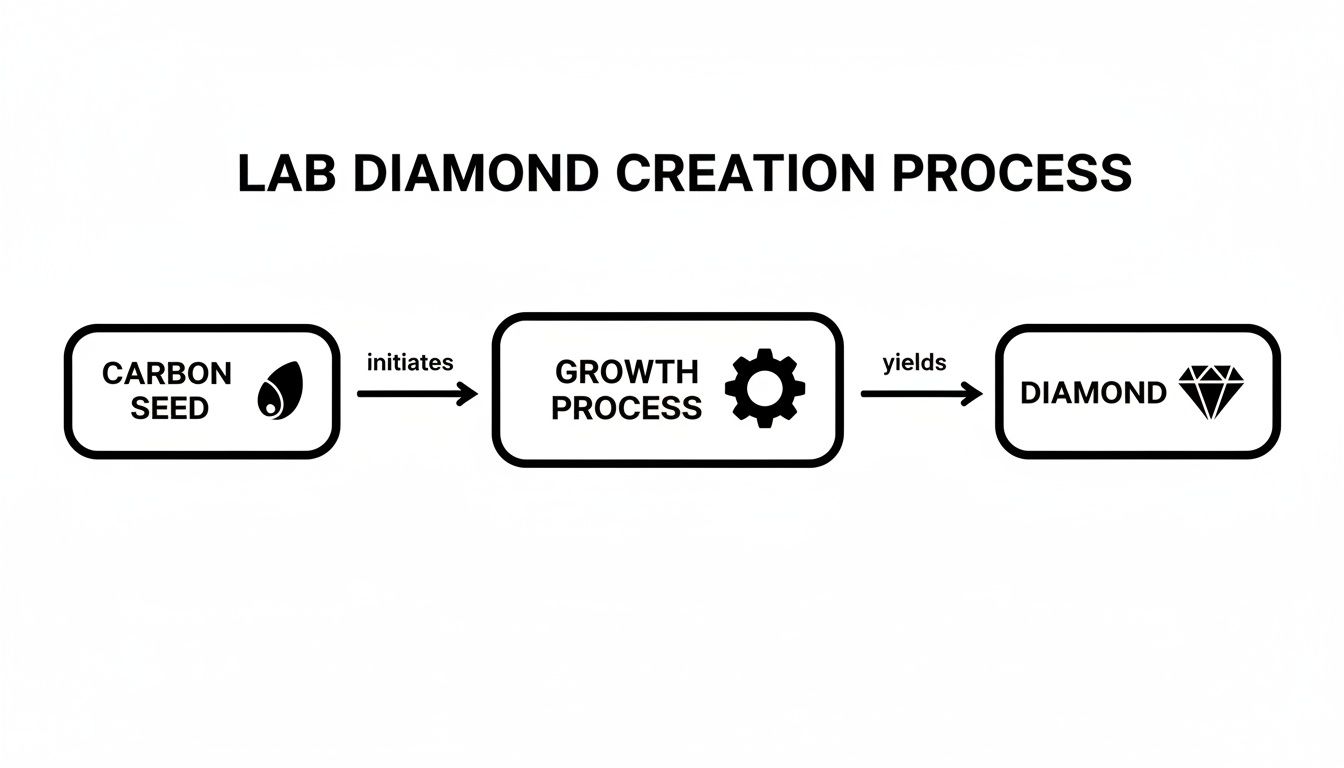
It all starts with a tiny diamond "seed," which is nurtured in a high-tech chamber until it grows, atom by atom, into a beautiful, high-quality raw diamond ready for cutting and polishing.
Market Dynamics and Trends in Canada
The rise of lab diamonds is fundamentally shifting the jewellery landscape, and we see this firsthand here in Canada. Jewellers across the country, especially in hubs like Toronto and Vancouver, are seeing a dramatic increase in clients asking for and choosing lab-grown options.
While many market reports are US-focused, Canadian trends are following a similar path. One recent survey found that 52% of newlyweds opted for lab-grown stones, a staggering jump from just 12% in 2019. Some experts even predict that lab diamonds will outsell mined diamonds within the next decade, with Canada expected to see a 15-20% lab diamond market share by 2025.
In the end, the choice is entirely yours. Both lab and natural diamonds offer the timeless beauty and durability that make them the ultimate symbol of love and commitment. The decision really comes down to what resonates with you most: the billion-year-old story of a mined stone, or the modern innovation, clear value, and guaranteed origin of a lab-grown one.
The Smart Value of Choosing Lab Diamonds
When we talk about diamonds, the conversation starts with sparkle but always lands on value. Choosing a lab-grown diamond isn't about settling for a "lesser" stone; it’s about making a savvy, informed decision that perfectly marries financial intelligence with your personal values. The biggest draw? A price difference so significant it completely changes the game for what’s possible within your budget.
Let's put that into perspective. Say you have a set budget for an engagement ring. With a natural diamond, that budget might land you a beautiful, but perhaps more modest, stone. With a lab-grown diamond, that very same budget could get you a substantially larger diamond, or one with a higher clarity or colour grade, without spending a single dollar more. That kind of financial flexibility is a game-changer, especially when designing a custom piece.
This power of choice means you can allocate your budget to what truly matters to you. Maybe you invest more in an intricate, handcrafted setting by an artist like Sevan, or perhaps you simply get to enjoy a breathtaking centre stone that you thought was out of reach.
Maximizing Your Budget
The price of lab-grown diamonds has evolved dramatically, making true luxury more attainable than ever. As the technology has become more refined, the cost to create these stunning gems has dropped, and those savings are passed right along to you. It's a fundamental shift in the market that empowers buyers to get more carat and quality for their money.
Here’s a real-world example of what that looks like: A jaw-dropping 2-carat, nearly flawless lab-grown diamond can often be found for under $5,000. A natural diamond with the exact same specs? It could easily set you back $50,000 or more. Today, it’s common to see lab-grown stones priced 80-90% lower than their mined counterparts—a staggering drop from a mere 20% difference back in 2018. This affordability has had a direct impact on what people are buying. Industry surveys now show the average carat size for lab diamond rings has climbed to 2.0 carats, outpacing the 1.6-carat average for mined diamonds. You can read more on these market trends in this insightful industry analysis.
What this really means is that the dream of a large, brilliant diamond isn't just a fantasy anymore. It’s a very achievable reality.
A Conscientious Investment in Your Story
Beyond the clear financial advantages, the value of a lab diamond is also deeply tied to ethics and sustainability. When you choose a lab-grown stone, you're investing in a story you can feel genuinely proud to tell—one of modern innovation and mindful choices.
A lab diamond offers complete peace of mind. Its origin is known and documented, guaranteeing it is 100% conflict-free. You are choosing a gem born from science, not one with a potentially fraught history.
For many couples in Canada, this certainty is a huge part of the appeal. They want their ring to be a pure symbol of their love, completely untainted by ethical questions.
The Environmental Advantage
Creating a diamond in a lab is a controlled, precise process that leaves a much smaller environmental footprint than traditional mining. While unearthing a natural diamond often requires moving massive amounts of earth and using huge quantities of water and energy, growing one is a far less disruptive process.
Here are a few of the key environmental benefits:
- Less Land Disruption: Lab diamond creation completely avoids the large-scale excavation that can scar landscapes and disrupt ecosystems.
- Reduced Water Usage: The process of growing a diamond uses a fraction of the water required for the industrial processes of mining.
- Lower Carbon Footprint: While growing diamonds is energy-intensive, the industry is making huge strides in efficiency and the adoption of renewable energy, leading to a cleaner process overall.
Ultimately, choosing a lab diamond is more than just a financial calculation. It’s a modern, conscientious choice that reflects a commitment to clarity, ethics, and sustainability. It’s a chance to wear a stunning piece of the future, knowing its creation was as beautiful as the gem itself.
How to Select Your Perfect Lab Diamond
Choosing a lab-grown diamond is a fantastic experience—it’s all about finding that perfect balance of beauty, quality, and value. The great thing is, the affordability of lab diamonds puts you in the driver’s seat. You get to decide which characteristics matter most to you and your design. Once you get a handle on the 4Cs—Cut, Colour, Clarity, and Carat—you'll be able to confidently pick a stone that delivers jaw-dropping sparkle for your custom ring.
Think of the 4Cs less like strict rules and more like a set of dials you can adjust to get the most out of your budget. Knowing which dials to turn up and which to turn down is the key to finding a diamond that looks incredible to the naked eye, without overpaying for technical grades you'll never see. This is where you can be a truly smart buyer.
Prioritize Cut Above All Else
If there’s one place to put your money when buying a lab diamond, it's the Cut. Hands down, cut is the single most important factor that dictates a diamond's sparkle, fire, and overall brilliance. This has nothing to do with its shape (like round or oval) and everything to do with the precision of its angles, facets, and proportions.
A masterfully cut diamond works like a tiny, perfect hall of mirrors. It pulls in light, bounces it around internally, and shoots it back out, creating that mesmerizing dance of light we all love. Even a diamond with perfect colour and clarity will look dull and lifeless if the cut is poor.
Key Takeaway: Never, ever compromise on cut. Always aim for an "Excellent" or "Ideal" cut grade from a reputable lab like IGI or GIA. This guarantees your diamond will have that stunning sparkle it was made for. It’s the one ‘C’ where spending a little more gives you a visible, undeniable return.
Smart Choices in Colour and Clarity
Here’s where you can be really strategic and make your budget work for you. While colour and clarity are important, their real-world impact isn't always as obvious as you might think, especially when it comes to lab diamonds.
Colour Grades Demystified Diamond colour is graded from D (completely colourless) to Z (light yellow or brown). For that classic, bright white look, you’ll want to stay in the "Colourless" (D-F) or "Near Colourless" (G-H) ranges.
- Smart Savings Tip: Honestly, the visual difference between a D and a G colour diamond is almost impossible to spot with the naked eye once it's set in a ring—but the price difference can be huge. Opting for a G or H colour lab diamond is a fantastic move. You get a beautiful, white-looking stone without paying the premium for a top grade you can't even see.
Navigating Clarity Clarity is all about the tiny internal features, known as inclusions, which are just microscopic remnants from the diamond’s growth process. The goal isn't to find a flawless stone; it's to find one that is "eye-clean."
An eye-clean diamond has no inclusions that are visible without magnification. You absolutely do not need to spring for a "Flawless" (FL) or "Internally Flawless" (IF) stone to get a visually perfect diamond.
- The Sweet Spot for Value: Look for diamonds graded VS1/VS2 (Very Slightly Included) or even a well-chosen SI1 (Slightly Included). Many SI1 lab diamonds are completely eye-clean and offer incredible value, freeing up your budget for a better cut or a larger carat size.
Understanding the Grading Report
Think of your diamond’s grading report as its official transcript. It’s an unbiased, third-party assessment of its quality. For lab diamonds, the most common and respected certificates come from the International Gemological Institute (IGI) and the Gemological Institute of America (GIA).
When you look at a certificate, here’s what to check for:
- Origin: It must be clearly marked as "Laboratory-Grown."
- The 4Cs: Double-check that the grades for cut, colour, clarity, and carat match what the seller told you.
- Laser Inscription: The report number is usually laser-inscribed on the diamond's girdle (its thin edge) for easy identification.
- Proportions Diagram: This chart gives you the technical details behind the diamond's cut quality.
A certificate from a trusted lab is your ultimate peace of mind, confirming you’re getting exactly what you paid for. To dig deeper, check out our guide on where to buy lab-grown diamonds online for more tips on making a confident purchase.
Connecting Your Choice to Your Vision
At the end of the day, every technical choice you make is in service of your vision for the perfect ring. The shape of the diamond—whether it's a classic Round Brilliant, a modern Oval, or a romantic Pear—really sets the tone for the entire design. By using the 4Cs to your advantage, you give yourself the freedom to get the exact shape and size that brings your dream ring to life, beautifully and within your budget.
Bringing Your Custom Jewellery Vision to Life
Here's where the real excitement of lab diamonds kicks in: the creative freedom they give you for custom jewellery. A budget that might have felt restrictive with a natural diamond suddenly opens up a world of spectacular possibilities. It completely changes the conversation from one of compromise to one of pure potential.
Think about it. You could go for that show-stopping centre stone and still have room in the budget for a delicate pavé band or a brilliant halo of smaller diamonds. This is what lab-grown diamonds bring to the table. They let you think bigger, putting the artistry and design of your piece front and centre, without being held back by price.
From Dream to Design
Choosing your lab diamond is the first real step in bringing your vision to life, and it’s a journey we take together. At Design by Sevan, this is the moment your ideas start to become something tangible—something you can one day wear. Our whole process is built around translating your style and story into a breathtaking piece of jewellery.
This is a true partnership. We start by listening, getting to know your taste, and then guiding you toward the perfect stone and a design that feels entirely you.
The ability to get a larger, higher-quality stone for the same budget is a primary driver in the custom engagement ring market. This shift allows for more creativity and personalization than ever before, making your dream ring an attainable goal.
The numbers back this up. Recent surveys show that affordability (31%) and quality (30%) are the biggest reasons people are drawn to lab options. With almost two-thirds of engaged couples in North America now considering lab-grown diamonds, the focus has clearly shifted toward getting the most beauty and personal expression for your budget. You can explore more on these industry growth insights.
Your Vision Is Our Blueprint
Every bespoke piece we create starts with a conversation, not a catalogue. We take your inspiration—a photo, a feeling, a memory—and turn it into initial sketches, working with you to refine every single detail until it’s just right. Having a lab diamond in the picture gives us the flexibility to focus on what truly makes a ring special: the craftsmanship, the setting, and the little touches that tell your story.
- Unleash Your Creativity: Now you can realistically consider that more intricate setting, add beautiful side stones, or even choose a fancy-shaped diamond you thought was out of reach.
- Focus on Artistry: You can direct more of your budget toward the handcrafted details and metalwork that distinguish a truly custom piece.
- Build Your Story: We can create a ring that isn't just beautiful, but is a meaningful symbol of your unique relationship.
Whether you have a crystal-clear vision or just the beginning of an idea, we're here to guide the process. Our expertise ensures your finished ring is not only stunning but is built with integrity to last a lifetime. To see how it all works, take a look at our guide on how to design a custom engagement ring in Toronto.
Got Questions About Lab Diamonds? We've Got Answers.
Choosing the right diamond can bring up a lot of questions. To make sure you feel completely confident in your decision, here are some straight-talking answers to the questions we hear most often.
Are Lab Diamonds “Real” Diamonds?
Yes, absolutely. A lab-grown diamond isn't a "fake" or a "simulant" like cubic zirconia—it's the real deal.
They share the exact same chemical, physical, and optical properties as diamonds that come from the earth. Both are pure carbon, crystallized into a perfect cubic structure. Gemological labs like GIA and IGI even use the same grading standards for both.
The only thing that separates them is their origin story. Think of it like a beautiful orchid grown in a state-of-the-art greenhouse versus one found in a remote jungle. They are both genetically identical orchids, just created in different environments.
Do Lab Diamonds Hold Their Value?
This is a big one. Right now, the resale market for lab diamonds isn't as established as the one for natural stones, which means they don't hold their value in the same way. However, their true value comes from the incredible savings you get right from the start.
That financial advantage allows you to invest in a larger, higher-quality diamond that might otherwise be out of reach, all without stretching your budget.
It's best to think of a lab diamond as a symbol of a personal milestone, not a financial asset. Its worth is measured in the daily joy and meaning it brings to you.
Can a Jeweller Tell the Difference Just by Looking?
Nope. Not even a seasoned gemologist can tell a lab-grown diamond from a natural one with just their eyes or a standard loupe. To the naked eye, they are indistinguishable.
They have the exact same fire, brilliance, and sparkle that make diamonds so captivating. The only way to tell them apart is with highly specialized equipment found in a gemological laboratory.
How Do I Care for My Lab Diamond Jewellery?
You care for a lab diamond the same way you would any diamond. Both lab-grown and natural diamonds score a perfect 10 on the Mohs scale of hardness, making them the most durable gemstone on earth and perfect for everyday wear.
A gentle cleaning at home with a soft brush, warm water, and a drop of mild soap will keep it sparkling. We also suggest bringing your ring in for a professional check-up every so often, just to make sure the setting is still tight and secure.
Ready to bring your vision to life with a beautiful lab diamond? At Design by Sevan, we specialize in creating custom engagement rings that tell your unique story.